Biosafety Level Facilities Plants Insects And Aquatic Organism
Biosafety level facilities are specialised research laboratories dealing with infectious agents and pathogens. Research involving infectious & genetically modified organisms requires the protection of the laboratory personnel, environment, and the community. In today’s research savvy world, it’s important to understand the different biosafety levels mandated by compliance organisations and how they’re differentiated.
The biosafety levels provide protective measures and command the work practices appropriate to the research.
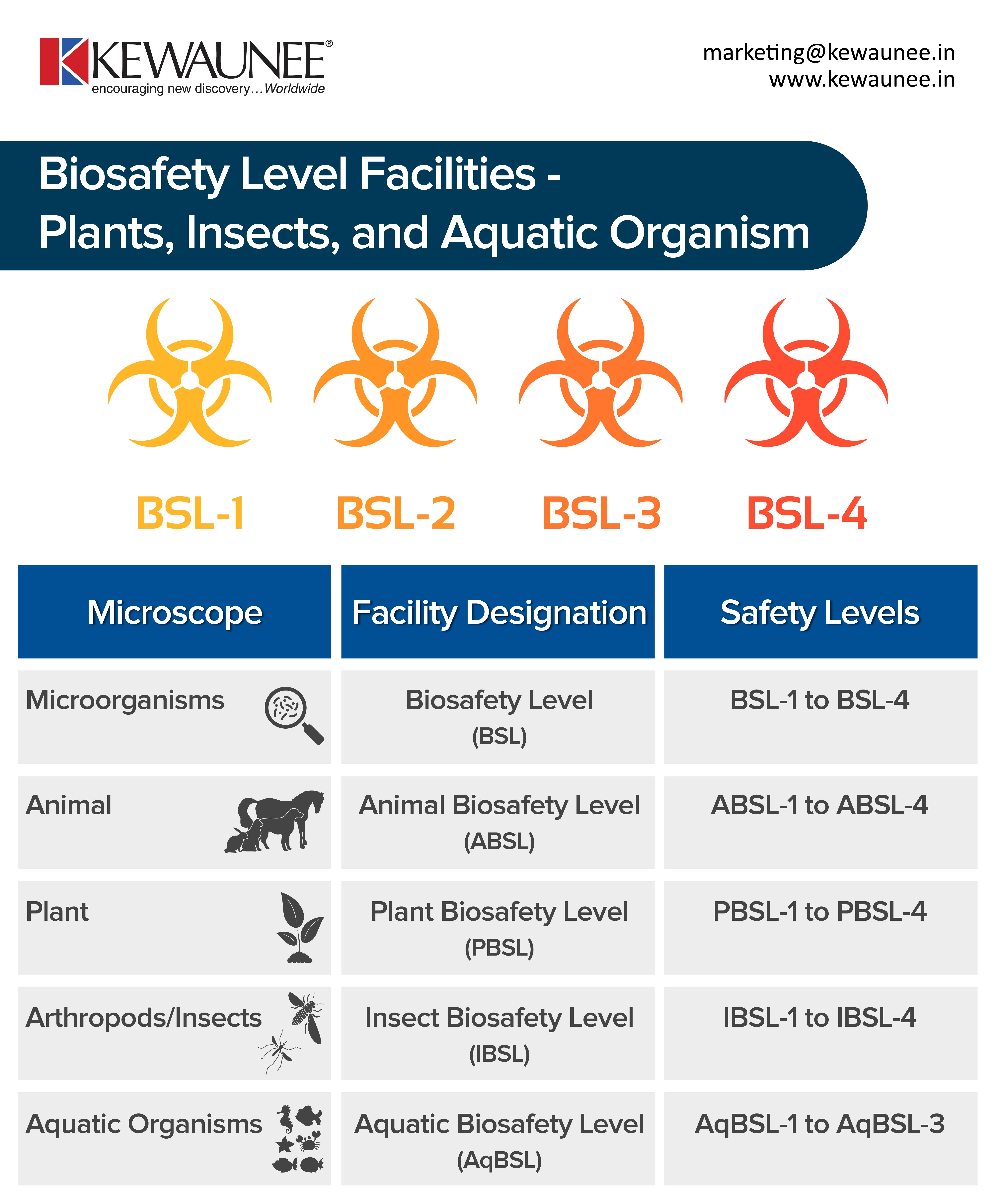
| Organism | Facility Designation | Safety Levels |
| Microorganisms | Biosafety Level (BSL) | BSL-1 to BSL-4 |
| Animal | Animal Biosafety Level (ABSL) | ABSL-1 to ABSL-4 |
| Plant | Plant Biosafety Level (PBSL) | PBSL-1 to PBSL-4 |
| Arthropods/Insects | Insect Biosafety Level (IBSL) | IBSL-1 to IBSL-4 |
| Aquatic organisms | Aquatic Organism Biosafety Level (AqBSL) | AqBSL-1 to AqBSL-3 |
Source: Department of Biotechnology, India
In our previous posts we explored the guidelines for BSL facilities and Animal biosafety (ABSL) facilities. In this blog, we’re going to focus on the biosafety level facilities for plants, insects, and aquatic organisms, as prescribed by the Department of Biotechnology in India.
Plant Biosafety Level (PBSL)
Depending on the nature of work, for experiments on plants, four biosafety levels laboratories are specified. The levels, PBSL-1-4, include structures comprising greenhouses, screen houses and flexible film plastic structures.
| Biosafety Level | Facility Description |
|---|---|
| PBSL-1 | PBSL-1 applies to structures comprising greenhouses, screen houses and flexible plastic film structures for:
|
| PBSL-2 | PBSL-2 applies to structures comprising greenhouses, screen houses and flexible plastic film structures for:
|
| PBSL-3 | PBSL-3 applies only to greenhouses for:
|
| PBSL-4 | PBSL-4 applies only to greenhouses for:
|
Insect Biosafety Level (IBSL)
Insect Biosafety Level (IBSL) Facilities are intended to prevent escape and establishment of the experimental arthropods into the natural environment and ensure the safety of the laboratory personnel in the facility.
| Biosafety Level | Facility Description |
|---|---|
| IBSL-1 | IBSL-1 are suitable for maintenance, rearing and to conduct laboratory level experiments with terrestrial arthropods that are:
|
| IBSL-2 | IBSL-2 are suitable for maintenance, rearing and to conduct laboratory level experiments with terrestrial arthropods that are:
|
| IBSL-3 | IBSL-3 are suitable for maintenance, rearing and to conduct laboratory level experiments with terrestrial and exotic arthropods that are:
|
| IBSL-4 | IBSL-4 are suitable for maintenance, rearing and to conduct laboratory level experiments with terrestrial and exotic arthropods that are:
|
Aquatic Organism Biosafety Level (AqBSL)
The purpose of Aquatic Organism Biosafety Level (AqBSL) Facilities is primarily to prevent escape of aquatic animal pathogens into the natural aquatic environment so as to protect the environment and prevent spread of infectious diseases to vulnerable aquatic animal populations.
| Biosafety Level | Facility Description |
|---|---|
| AqBSL-1 | AqBSL-1 applies to storing, rearing and experiments with aquatic organisms that are:
|
| AqBSL-2 | AqBSL-2 applies to storing, rearing and experiments with aquatic organisms that are:
|
| AqBSL-3 | AqBSL-3 applies storing, rearing and experiments with aquatic organisms that are:
|
| AqBSL-4 | At this time, there are no pathogens requiring BSL-4 type containment for aquatic organisms i.e. AqBSL-4. |
Kewaunee International Group

Kewaunee, the global leader in total laboratory solutions, empowers organisations to achieve competitive advantage through safe, efficient, and contemporary laboratories. In existence since 1906, Kewaunee powers the laboratories for over 5,000 customers in more than 100 countries.









Comments are closed.