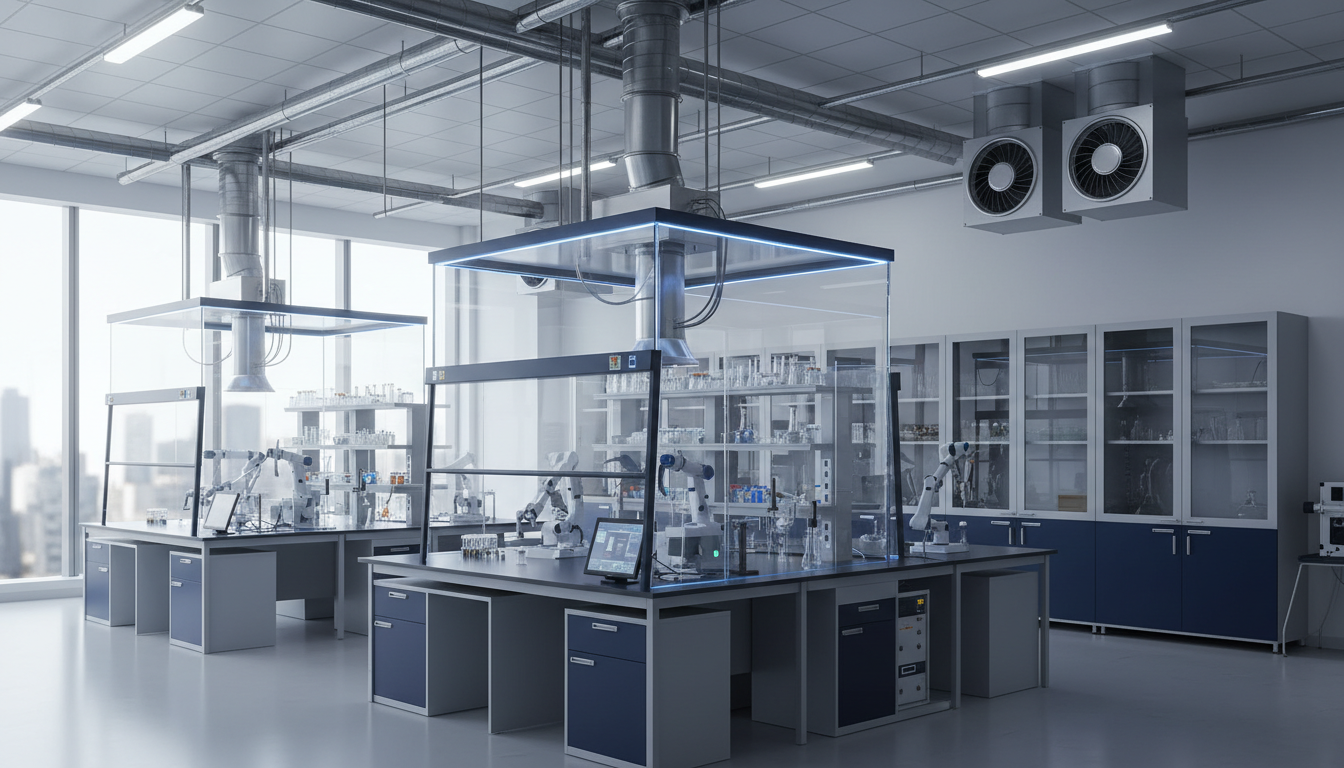
Ensuring the air in a lab is safe for occupants, and the fog it clear of toxic chemical gases and noxiously strong smells that can cause immediate physical harm as well as the build-up of hazardous substances over time on interior surfaces and upholstery that can be re-released when disturbed can be a daunting task. Proper ventilation removes unwanted contsminents that include vapors, particles, fumes, dust, and spores. While dilution ventilation is often sufficient, local exhaust ventilation can be added as needed. This is less draughty, and can remove contaminants quickly at source before thery have a chance to disperse with the airflows. Remember also that some vapors are heavier than air and will sink and accumulate except removed or diffused by local exhaust.
The Role of Ventilation in Laboratory Safety
It’s essential in all labs, but especially in teaching labs, where new experiments happen all the time. And don’t forget computer labs or server rooms: poor ventilation can ruin equipment or make an air-conditioned lab as hot as an oven.
How do we design a good laboratory when it comes to readjusting our ventilation systems for a new age of digital laboratories? Does anybody really know what ventilation rate is required?
Mitigating Chemical Exposure and Toxic Fume Risks
How do you know if you have enough of these devices? The magic number should be the result of careful evaluation. According to best practices, airflow should be between 0.4 and 0.5 meters per second (80 to 100 feet per minute), with a face velocity not less than 0.3 meters per second (60 feet per minute). There are international standards and guidelines based on the type of application of chemical hoods, but all of them take the required face velocity into account. It’s the most important factor in determining whether your fume hoods are working correctly and whether you have enough of them. Face velocity and airflow velocity are the key factors that ensure a fume hood’s capture efficiency. Too much from one, or not enough from the other, leads to poor containment performance. And that’s another reason why labs designed with a specific number of hoods to serve a specific number of users can be at risk.
Are they glaring errors in the lab design? Probably not, but we often see the cheapest ventilation and air monitoring systems installed. It’s true that these systems cost more upfront, so savings can look significant. But what’s the real cost?
Primary Laboratory Ventilation Systems
Many labs also feature perimeter air ventilation with adjustable diffusers. These change the air currents along room edges to keep lab workers safe. Unfortunately, even the best-engineered ventilation system in a traditional laboratory has limitations. That’s because airflow isn’t consistent everywhere. Middle-air zones receive much less fresh air, and depending on how chemicals and fumes move, this can be a major safety challenge.
Standardized equipment makes sense if you plan to populate all workstations with exactly the same devices. But rarely does a project remain that simplistic. Reprogramming instruments for future projects is more likely to be required. Think carefully about how many devices would be adversely affected by standardization, it’s crucial to be able to reconfigure, repurpose, or upgrade actual devices or the “outputs” associated with such devices. In a high-throughput screening lab, for instance, well plates are a commodity. You wouldn’t worry too much about whether they should be standardized. Alternatively, an optimized liquid handler plate-based movement might be changing tips, which requires very careful standardization.
Energy Efficiency in Modern Ventilation
Large ventilation systems in laboratories are energy-hungry beasts. And when you consider that a lab can be up to 100% air change dominated, continuously replacing the air to maintain the highest level of indoor air quality, it’s not difficult to see why. It’s vanilla flavoured energy consumption. Large ventilation systems operating 24 hours a day with the knowledge that many fume cupboards are consuming electricity even when not in use. A downstream flow of money and carbon.
Certainly, it’s an exciting and varied field, as much about the cutting-edge challenges of ecosystem modeling as about the very practical issues of ventilation design. What could be more essential than air we can breathe? Our expertise makes a real difference to people’s lives and the future of our beautiful, beleaguered planet.
Balancing Air Replacement with HVAC Power Consumption
How much are we really aware of the air we breathe? Let me rephrase that, because I’m not sure anyone really knows exactly what they’re breathing at any given moment. Whether it’s the laboratory, your office, or even your living room, probably most people don’t spend too much time thinking about indoor air quality.
Work with an experienced provider like Kewaunee when planning a new lab. They design your laboratory to meet safety requirements, remain flexible for future needs, and use energy wisely. The right environment is worth it in safety, comfort, and long-term savings.
Conclusion
Ventilation is not just another detail in a lab construction project. It’s your chemical hygiene plan’s first line of defense. But no one ever said effective ventilation is easy, especially when you think about the full dictionary definition of effective: you want to do the most without waste. Too much air is unnecessarily costly in construction, energy bills, and environmental footprint. Too little air puts people and projects in harm’s way. How do you get it just right? We start with what probably isn’t a stretch to guess you’re already focused on, controlling those chemicals you use to reduce risk and exposure. Then, keep reading. Here are 8 more ideas that might be new or so obvious; they’re easy to overlook.










Comments are closed.